CREATORSEAL™ vs Copyright Registration
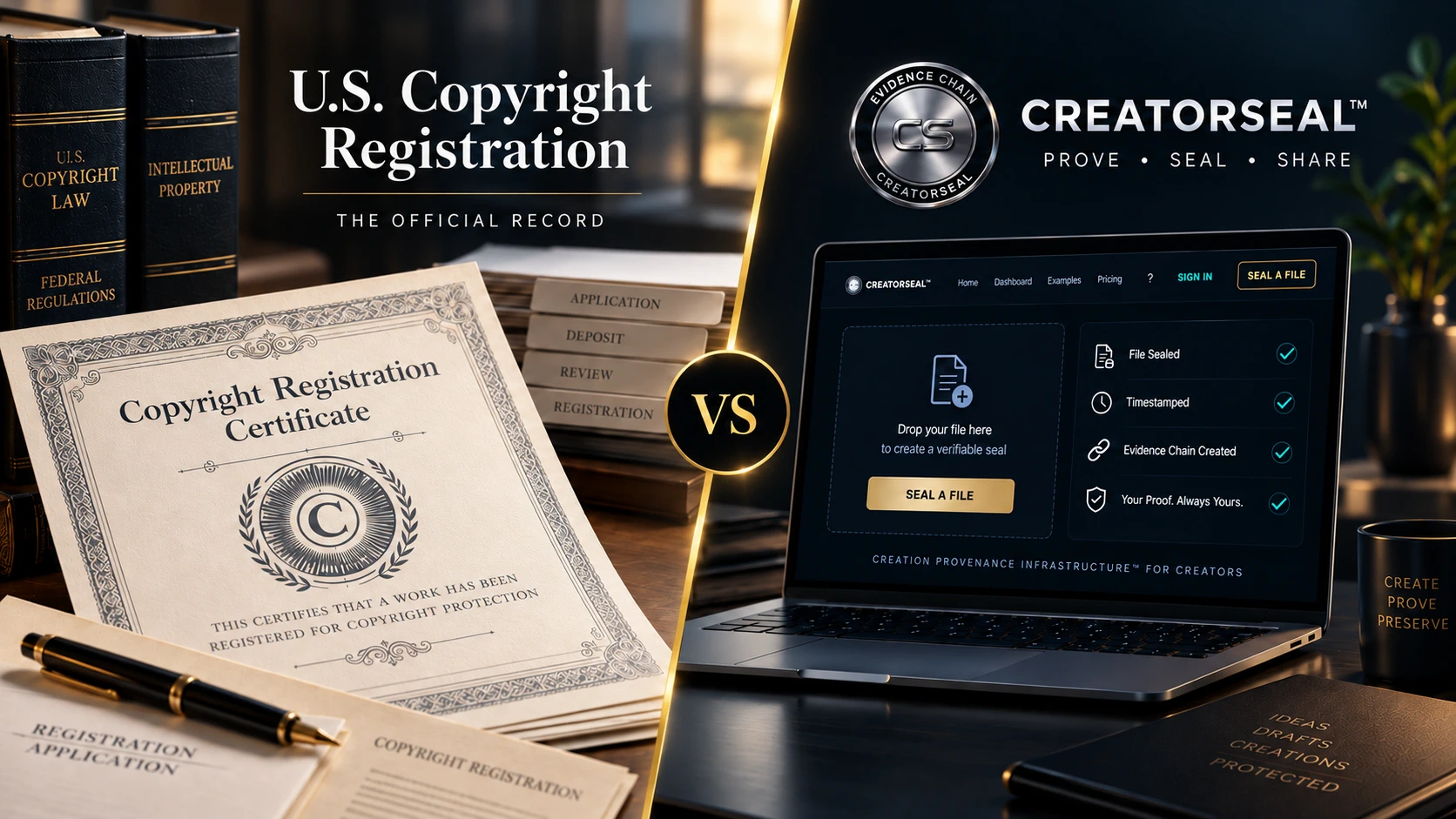
Creators ask which of these to use as though it were a choice between two products. It isn't. One is documentation made in seconds on your own machine; the other is a government filing that changes what is possible in court.
They solve different problems at different stages, and the confusion costs people real remedies. Here is what each actually does.
This is general information about U.S. law, not legal advice.
What Copyright Registration Actually Does
Registration does not create your copyright. That exists automatically the moment your work is fixed in a tangible form. What registration does is add legal capability on top of a right you already hold — four things, and they are the entire reason it exists.
It lets you sue. Under 17 U.S.C. § 411(a), an infringement action on a U.S. work generally cannot begin until the Copyright Office has acted on your application. In Fourth Estate Public Benefit Corp. v. Wall-Street.com (2019), a unanimous Supreme Court held this means the Office must have granted or refused registration — filing is not enough. Processing takes months, which is a practical reason not to wait until there is a problem.
It preserves statutory damages and attorney's fees. This is the one with a deadline. Under § 412 those remedies are unavailable for infringement that began before registration, unless you registered within three months of first publication. Miss that window and you are limited to actual damages and the infringer's profits, which are harder to prove and often not worth pursuing.
That matters more than it sounds. Under § 504(c), statutory damages run from $750 to $30,000 per work and as much as $150,000 where infringement is willful. Actual damages for an individual creator are frequently too modest to justify litigation at all, so the availability of statutory damages is often what makes a claim viable — and what makes the other side take a letter seriously.
It creates a legal presumption. Under § 410(c), a certificate obtained before or within five years of first publication is prima facie evidence of the copyright's validity and of the facts stated in it. The burden shifts to the other side.
It creates a public record, which matters for licensing, due diligence, and chain-of-title questions.
What registration does not do is also worth saying, because it gets oversold in the other direction. It does not prevent copying. It does not cover your drafts individually. It is not practical for work that changes weekly. And it produces no record of which version existed when — an application has a filing date and a deposit copy, not a per-revision timeline.
What CREATORSEAL Does
CREATORSEAL creates a dated record that a specific file existed in a specific form at a specific moment. A SHA-384 fingerprint of the file is generated on your device, an independent Time Stamping Authority signs that fingerprint under the RFC 3161 standard, and you keep the resulting Evidence Bundle.
Four properties follow from that:
It works at draft stage. Pitch decks, concepts, rough cuts, treatments, unfinished manuscripts — the material shared before anything is final, which is exactly when sharing feels risky. Registering each iteration is not realistic; sealing each one takes seconds.
It is repeatable. Seal every version that matters and you end up with a dated sequence showing how the work developed. That sequence is often more informative than any single finished artefact.
Your file stays private. Only the fingerprint is transmitted. Registration involves depositing the work with a government office, which some creators would rather avoid for unpublished material.
It covers what registration does not reach. Client deliverables, work-for-hire output owned by someone else, internal documents — plenty of files are worth a record without being worth a filing.
Stated plainly: a timestamp confers no legal rights. It does not let you sue, does not unlock statutory damages, does not establish authorship, and does not prevent copying. It may support discussions with attorneys, clients, platforms, or partners. Any tool claiming more than that is overselling.
Where They Overlap
Both are about being able to show something later rather than assert it. Both work best before a problem exists, and both lose value when left until one does. Both are concerned with timing — registration with the date you filed, a seal with the date a particular file existed.
And both sit alongside the copyright you already own. Neither one grants it.
That shared purpose is why they get confused. The overlap ends at the point where law begins.
Where They Are Different
| Trusted timestamp | U.S. copyright registration | |
|---|---|---|
| What it is | A dated third-party record | A government filing |
| Creates legal rights | No | Yes — standing and remedies |
| Time to complete | Seconds | Months |
| Cost | Low — a subscription covers unlimited files | A filing fee per work |
| Repeatable per version | Yes, routinely | Impractical |
| Works before publication | Yes | Yes, by a different process |
| Your file becomes public record | No | The deposit goes to the Office |
| Required to sue in U.S. federal court | No | Generally yes |
| Unlocks statutory damages | No | Yes, if timely |
| Shows who created the work | No | Creates a presumption, if timely |
Read the "creates legal rights" row twice. It settles most arguments about which to use, because only one of these two is a legal instrument at all.
When to Register
Register when the work is finished and carries real value — a completed book, an album, commercially licensed photography, software, a brand asset earning revenue, anything you would actually litigate over.
Register around publication, not around trouble. The three-month window under § 412 is the single most consequential date in this whole topic, and by the time there is a dispute it has usually closed.
Register selectively. Most of what a working creator produces does not warrant a filing, and pretending otherwise just means nothing gets registered at all.
When to Seal
Seal before a file leaves your hands. A concept going to a client, a deck going to an investor, a manuscript going to a beta reader, a demo going to a collaborator.
Seal each version that matters rather than only the final one. The value is the chain, not any single record.
Seal the things that will never be registered — the client work, the drafts, the internal documents, the work-for-hire output. Those are the files where no other record will ever exist.
When to Use Both
For work with commercial value, the sequence is straightforward:
- Seal as you work. Each meaningful version, before it is shared.
- Register at publication, inside the three-month window, to keep § 412 remedies available.
- Keep both records together. The sealed bundles document the path; the certificate carries the legal weight.
The common failure is neither — no pre-sharing record, and a registration window that closed months ago.
Practical Creator Scenarios
A freelance designer delivering a logo. Seal each concept round before presenting it, and seal the final delivery file. Register only if the mark becomes a client's primary brand asset and the contract leaves you holding the copyright. Most logo work never needs a filing; all of it benefits from a dated record of what was sent and when.
A novelist querying agents. Seal each manuscript version before it goes out. Do not register before querying — reputable agents do not steal manuscripts, and the filing is better spent at publication, inside the three-month window.
A photographer licensing commercially. Register, and look at group registration options, which change the per-image economics considerably. Seal the RAW files and selects before delivery, since the deposit copy will not show which frames you shot or when.
A founder sharing a pitch deck. Seal each version before sending it. Registration is rarely worth it for a deck that changes weekly, and copyright does not protect the underlying idea in any case — only your specific slides.
Outside the United States
Copyright is automatic in Berne Convention countries, and many have no registration system at all — the UK among them. Everything above about suing and statutory damages is a U.S. feature, tied to U.S. federal court.
Creators elsewhere should check local rules; some countries run voluntary deposit systems with their own effects. Where you might one day need to enforce in the U.S., U.S. registration can still be worth considering.
Common Questions
Is CREATORSEAL a copyright registration alternative?
No. It is not an alternative, a substitute, or a cheaper version. It is documentation that sits alongside registration and does a different job.
Do I need to register copyright if I use a timestamp tool?
Yes, where legal remedies matter. A timestamp does not substitute for registration in any respect.
Is CREATORSEAL better than registering copyright?
That compares two things that are not comparable. Registration gives you standing to sue and access to statutory damages. A timestamp gives you a dated record in seconds, as often as you like. Neither does the other's job.
Timestamp tool vs Copyright Office — which should I do first?
Seal first, because it takes seconds and works at any stage. Register when the work is finished and worth it.
What if I missed the three-month window?
Register anyway. You can still sue and still recover actual damages; what is lost is statutory damages and fees for infringement that began earlier.
Important Disclaimer
CREATORSEAL is not a legal service and does not replace copyright registration, contracts, NDAs, or legal counsel. It helps creators create and preserve proof records for digital files so they can maintain a clearer documentation trail.
This article is educational and is not legal advice. It describes U.S. federal copyright law; other countries differ, and many have no registration system. Fees and processing times change — check the Copyright Office directly. For your own situation, consult a qualified attorney.
Sources: 17 U.S.C. § 408 · § 410 · § 411 · § 412 · § 504(c) · Fourth Estate Pub. Benefit Corp. v. Wall-Street.com, LLC, 139 S. Ct. 881 (2019) · Circular 1, Copyright Basics · Current filing fees
Related: Do I Need to Register My Copyright? · CREATORSEAL vs Poor Man's Copyright · CREATORSEAL vs Notary
Part of a family of evidence-first tools by Tanya M. Lawson.
Understanding these distinctions is not about being paranoid — it is about making informed decisions before you share your work. The best time to build your proof trail is before anyone else has seen the file.
Seal early. Register when ready.
Build the proof trail before you share the file. Add formal registration when the work is done.